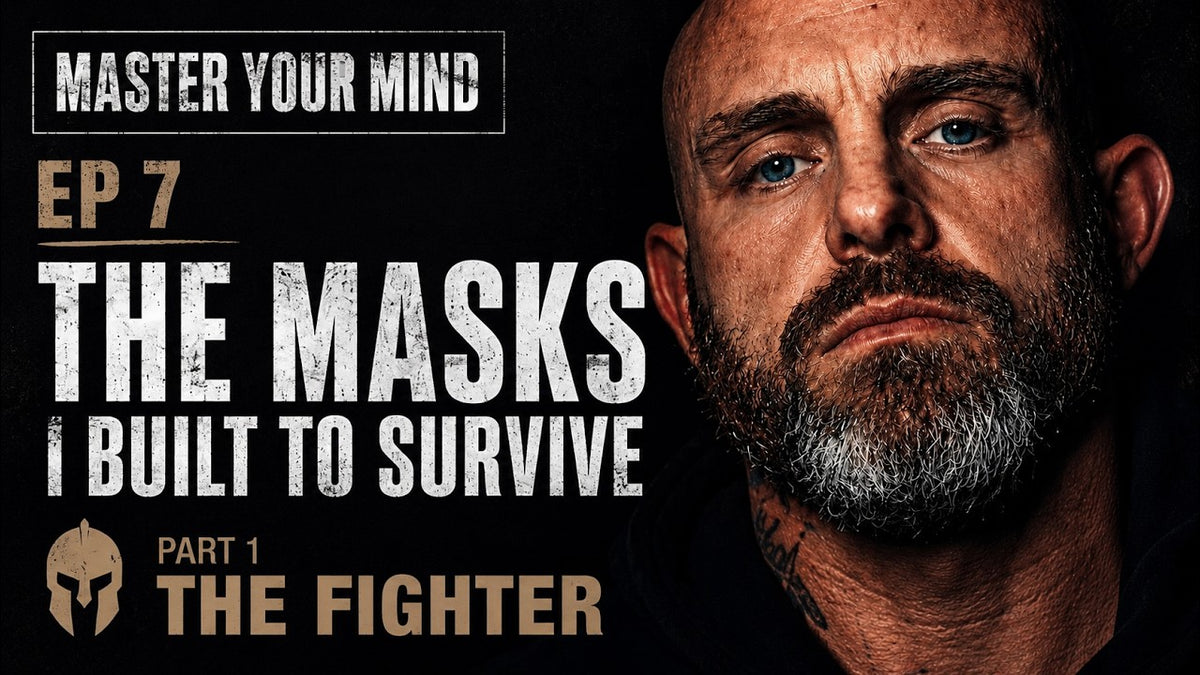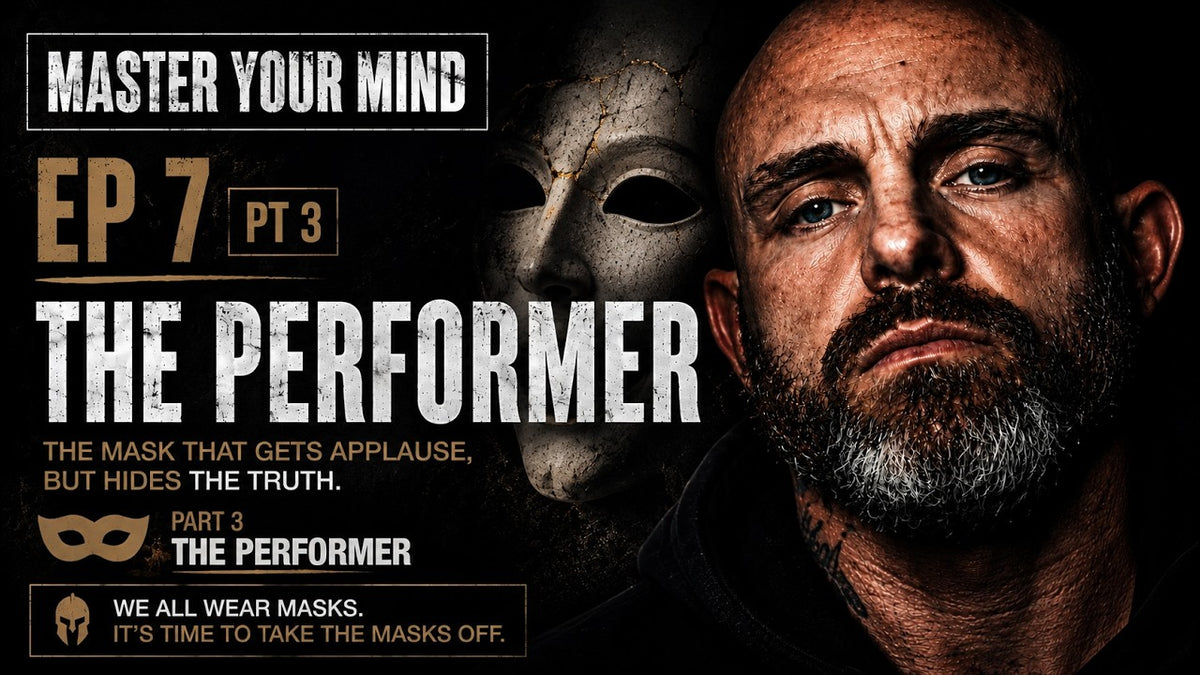
The Performer Mask: Why It's More Dangerous Than the Fighter and the Pleaser Combined
Watch the full episode: Master Your Mind EP7 Pt 3 – The Masks I Built to Survive: The Performer
Of the three masks I built, the Performer is the one I've had the hardest time talking about.
The Fighter protected me. The Pleaser made sure no one would leave. The Performer had a different job: make everyone believe nothing was wrong. That I was successful, in control, that I had it all figured out — coming from a place of superiority, not survival.
None of it was true. I was a mess. I hadn't dealt with any of what the Fighter or the Pleaser were reacting to. But if I looked like the guy who had it handled, I figured people's attention would stay on that instead of drifting toward the other two masks underneath. It's not vanity and it's not ego. It's management — making sure the Fighter and the Pleaser never got exposed, because if they did, I'd have to confront things about myself I wasn't ready to admit, let alone let anyone else see.
The chameleon
The clearest way I can describe what this mask actually does: I could sit down with a homeless person on the street or a multimillion-dollar CEO and hold a fluent, logical conversation with either one, no adjustment needed. That's not range. It's practice — adapting fully to any room, any person, any stakes, without the adaptation ever registering as effort.
It's a step past people-pleasing. The Pleaser abandons itself to keep someone happy. This is something else — closer to a small form of manipulation, and it served me well in exactly the world you'd expect: when I was living outside the law, surrounded by people I couldn't afford to misread.
Where it went dark
Getting that good at hiding my own struggles taught me something I didn't expect: everyone else is doing the same thing. They're just less aware of it than I thought I was. Reverse-engineer that, and you get an ability to find people's weaknesses, use them as leverage, and extract what you want.
I'll give you the real version, not the softened one. If someone owed money and I couldn't take them on physically, and I knew they were cheating on their partner, I'd dig up the proof and use it as leverage to get the money anyway. That's what the Performer actually gave me — an understanding of human nature built from a genuinely dark place, on the logic that if I was capable of it, other people had to be too.
I'm not proud of that. At the time I told myself the situation justified it — the person owed money and was doing wrong on both counts. But underneath that justification I still knew it was wrong, and there was a stretch where I seriously wondered if something was actually broken in me. Was I a narcissistic psychopath? Could I hurt someone and feel nothing? That question scared me more than almost anything else in this whole trilogy, because even while I was doing it, some part of me knew.
Every time, it racked up debt — not financial, emotional. Karmic, if you want the word for it. And a wrong doesn't cancel out a wrong. It's still wrong, regardless of what came before it. I've paid that debt back in full, with interest, since — but that's a separate conversation from what it cost me at the time.
The cost
The Performer cost me trust in myself. It cost me self-respect — I didn't like the man looking back at me in the mirror, because no matter how I framed it in the moment, I knew what I was doing and knew it was wrong. The remorse just hadn't caught up yet.
Hiding that much darkness for that long also cost me happiness, plain and simple. Every goal the Performer helped me hit came with an equal amount of happiness quietly leaving through the back door. I was the one running both sides of that ledger. I have to own that.
The turning point
About two years after rock bottom — around the same stretch where I was rebuilding the parts of my life I talk about elsewhere in this trilogy — I started sitting with who I'd actually become, and what it took to get there. That's when it turned. The shame and guilt from carrying this mask for so long got heavy enough that I never wanted to feel it again, and that was the push into actually confronting it instead of managing it.
Naming it was the first step. The second was radical transparency — talking about it out loud, on camera, in conversation, whether or not the person I was talking to particularly wanted to hear it. I latched onto every chance to say it plainly, because forcing myself to voice it was how I taught myself it was survivable to be seen.
And I'll be honest about what that costs: if being authentically me meant losing a relationship, I decided I was willing to let it go. Because if I can't be myself around someone, the real question underneath that is — was that ever a good relationship for me to begin with?
Integration
Here's the part I didn't see coming. The same skill that let me read people well enough to exploit them is the skill that now lets me help them. When someone talks to me — in coaching, in the program, anywhere — I can see what they're hiding and where. The only thing that changed is what I do with it. I used to use it against people. Now I use it for them.
That capability is a big part of why The Unbroken Mind's coaching and course modules look the way they do. I understand what most people are performing on a given day, because I used to run a much darker version of the same operation. It's not a coincidence — it's reverse-engineering.
What the trilogy adds up to
None of these three masks — Fighter, Pleaser, Performer — were something I sat down and chose to build. They were necessity. Your subconscious finding a way to survive whatever it's dealing with. If you recognize yourself in any of this, that's the first thing to let go of: the shame of thinking you chose it. You didn't. It chose you.
The second thing is that recognizing a mask doesn't mean discarding whatever built it. It means deciding what it's for now. Every capability underneath these masks can run in either direction — toward damage or toward use. That choice is the only part that's actually yours.
If you're working through your own version of this, I built a Shadow Work Field Guide — the Mask Cycle to Survive — that walks through breaking these patterns down step by step. It's on the website if you want somewhere to start.
Previous: The Pleaser Mask (EP7 Pt 2) | Next: Childhood Trauma (EP8)