What I Didn't Know Was Narcissistic Abuse — Until I'd Already Lived Through Three of Them
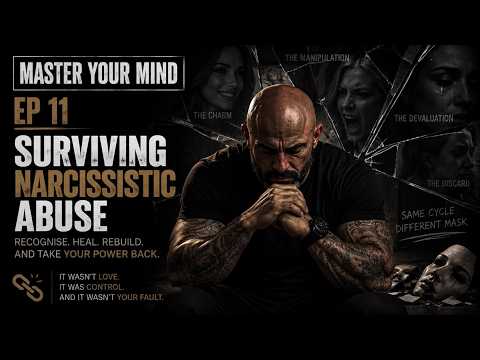
Watch the full episode: Master Your Mind EP11 – Surviving Narcissistic Abuse
I'm not a professional. I'm not diagnosing anyone in my past, and I'm not naming names. What I am doing is telling you what I lived through, and what it took me years to actually see clearly — because I think a lot of you are either in it right now or just coming out of it, and nobody handed you a map either.
The pattern I couldn't see while I was in it
There were three relationships that shaped how I understand this now. The first lasted about four years, starting when I was in my early twenties — the kind of attachment where if I wasn't around this person, I was in physical pain. I thought that was love. It was a trauma bond, and it was made worse by heavy drug use on both sides, which gave me a built-in excuse every time something felt off: was I actually seeing this, or was I just high, or tired, or overreacting? I spent so much time questioning myself before I'd even raise something that mattered, that after a few years I'd stopped trusting my own read on reality — not just in that relationship, but everywhere.
That relationship ended with a phone call I was never meant to hear, a confrontation, a suicide threat aimed at keeping me from leaving, and — when I still tried to go — a false claim to a mutual friend that I had physically assaulted her. I never have, not once, not with anyone. My friend asked her to show him the bruises. There weren't any. But the accusation itself is the point: when someone loses control over you, some people will go to real lengths to control the people around you instead, and to wreck your name on the way out. That kind of experience changes how you see people. Permanently.
The second relationship followed the same shape from a different angle — gaslighting about who she was talking to, being told I was "paranoid" for asking for basic transparency, and then, when I wouldn't drop it, watching my own social circle in a new town turn against me for reasons nobody would explain. I ended up in fights I didn't understand and more than one night in a watch house, and I still don't fully know what was said about me. I just know who paid for it.
The third one is the one that actually broke me, and it wasn't the most dramatic — it lasted nine years, and for most of it I genuinely believed I'd found the person I'd marry. That's exactly why it did the most damage. The gaslighting was quieter: agreed-on responsibilities that quietly didn't happen, and when I asked why, I was the one being "too much." I was so attached to the future I'd pictured with her that I stopped weighing what I was actually seeing. She ended up involved with my own boss, at a job I'd gotten her. When I found out, I still ended up apologizing. When we tried to rebuild and things stayed distant for medical reasons for months, one honest admission from me about being human got turned into me being the villain of the relationship. I walked away from that one hating what I saw in the mirror.
I'm going to leave some of what happened in that last relationship out of this. Not because I'm ashamed of surviving it — because some of it isn't mine to spell out in a video like this. What I will say is that it was enough to send me into eighteen months of real isolation, and that isolation is where my actual self-development work started. So no, I wouldn't wish any of it on anyone. But I'm not going to pretend it did nothing either.
Why it kept happening to me specifically
Here's the part I needed someone to say to me a long time before anyone did: none of this works on people who don't people-please. If your instinct, when someone you love is uncomfortable, is to immediately question yourself and smooth it over — you are the exact profile this pattern is built to find. The need to keep someone happy will override your ability to see what's actually in front of you, and that's precisely why threats of self-harm or abandonment show up right when you try to leave. They work on people who are terrified of being the one who caused the pain. If that's you, that's not a character flaw. It's just the thing to be aware of.
There's a side effect of surviving this that almost nobody talks about: it can go on to wreck a genuinely healthy relationship afterward. My first healthy relationship, the first one where the other person wasn't trying to hurt me, fell apart partly because I never stopped waiting for the other shoe to drop. I turned small, normal relationship friction into evidence of a pattern that genuinely wasn't there. That's why I now tell people to actually be alone for a while before dating again — not casually seeing someone, not "just sleeping with people," fully alone — long enough to learn to sit with discomfort without using another person, or a substance, to make it go away.
What I actually check for now
I don't operate off vibes anymore. I run three checks.
First: how does my nervous system feel around this person? Anxious, uncertain, never quite settled — that's information, not paranoia.
Second: when I raise something calmly, do I get accountability or do I get turned into the problem? A person who can say "you're right, I hear you" is showing you something completely different from a person who makes your discomfort about their ego.
Third, and this is the one that matters most: patterns over time, not incidents. One bad moment isn't a red flag. A promise to change, followed by three, four, five months of the exact same behavior, is.
Actions over words
I can't say this one enough: pay far more attention to what people do than what they say. Most of us — myself included, for years — would rather believe a comfortable lie than sit with an uncomfortable truth about where we actually stand. Watching behavior instead of listening to explanations is the single biggest shift that's protected me since.
And to be clear — none of this means you stop loving someone the moment you see a pattern that doesn't work. You can love someone completely and still recognize that what's happening between you isn't sustainable, and make the call anyway. That's not a contradiction. That's the whole point.
Previous: Masculinity Today (EP10) | Next: The Ego Death (EP12)