What Isolation Actually Did For Me (And Why I Think It's Necessary)
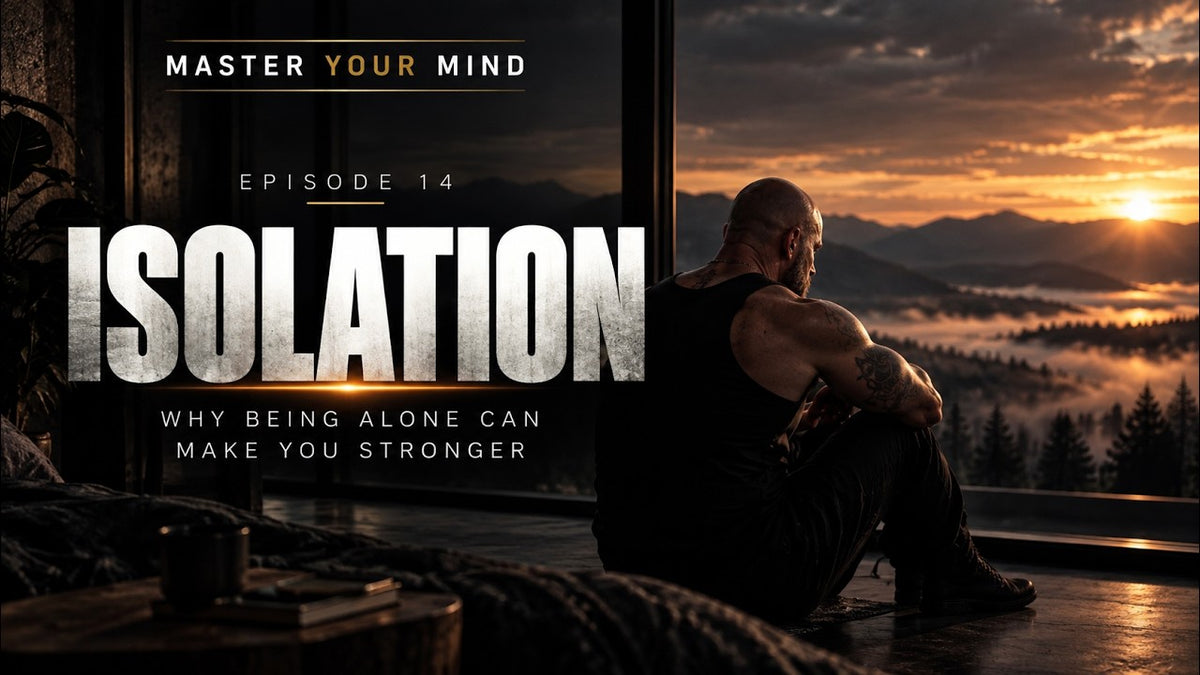
Watch the full episode: Master Your Mind EP14 – Isolation
I want to talk about isolation — what it did for me, and why I believe it's something genuinely necessary on the journey of changing your life. Not the version people romanticize. The version that gets forced on you.
How it happened
I didn't mean any of it. It was forced onto me — that's just how it happened. I've been through it multiple times now: the first time for eighteen months, the second about seven or eight months after that. I'd left the club I was previously in, ended a nine-year relationship, and found myself not wanting to see anyone. A big part of that was the sheer amount getting spun about both situations at once — and when that's happening, the last thing on your mind is spending time with people, because it genuinely hurts. It hurts when people you thought would always have your back are no longer there.
I'm not saying this like I'm a victim. I knew the risks in the life I was leading at the time, in more than one relationship. Three worlds collided at once, and only one of them could survive. I won't go into the details — dropping names isn't who I am. But when you've built your identity, your plans, your bonds around people for that long, those things are extremely hard to let go of. Having everyone you knew turn on you overnight was horrific, and there was no one I could lean on. I had to take the brunt of it alone.
What isolation actually removed
Isolation removed every distraction. People, substances, and every excuse I'd been using my whole life — the people-pleasing, "I'm just a loyal person," all of it — none of it had any weight anymore. I didn't have anyone to take care of, which removed distraction in itself. When you go from a full life of people needing things from you to nothing, all that productivity that used to distract you from looking hard at your life disappears too. I was sitting in a rental with nothing but myself and my two dogs, and I'll say till the day I die: they saved my life. Having to feed them, walk them, take care of them gave me some form of routine even when I was feeling sorry for myself.
The questions I had no answers for
What that isolation gave me was the ability to ask questions I had absolutely no answers for. What did I want out of life? What makes me happy? At thirty-six, I'm not saying you should have every answer, but you should have some sense of what makes you tick. I had none of it.
There's an analogy I've mentioned before, about an eagle that reaches around forty and has to fly into the mountains, tear out its own feathers and talons, smash its beak on a rock, and wait in the cold for sharper ones to grow back. That's genuinely what that isolation felt like — a place I had to strip everything off myself: the excuses, the identity, the patterns that had been accumulating for thirty-six years. I realized I'd been using my own history as an excuse to be a certain way and feel justified for it — which is, in a way, more messed up than some of what I'd actually been through.
The question that hit hardest: I realized that if I had a daughter, I wouldn't want her to marry a man like me. There's no word for how that landed. I'd told myself for years I was an upstanding person, that I'd always look after a woman, defend her. But looking back at what I'd put partners through — not abuse, but expecting them to accept things about me I wouldn't have accepted if the roles were reversed — there was nowhere to hide from that. You're forced to sit in the pain, the shame, completely alone.
Rebuilding from less, not more
I've never been the type to stay down. I've been knocked down plenty, but I've always managed to pick myself up. This time, I made a conscious choice looking at myself in the mirror — out of shape, having used drugs for a long time, chewed up and spat out. That was fuel enough to never go back. It wasn't a beautiful burst of motivation. It was pure spite, anger, from everything that had been said about me. That fuel pushed me into rebuilding.
The first thing I had a grip on was the gym, because I already loved it — it gave me structure inside all the external and internal mess. I latched onto it with both hands. Small wins on food, cardio, training built real confidence. Later, going through a landlord bankruptcy that nearly cost me the rental pushed me to save the deposit and build the house I live in now. Around that time I stumbled onto Joe Dispenza and Jordan Peterson, and that started changing what was going into my head. Everything started to shift.
I'm not saying it's impossible to grow while still in the life — I've coached people who have. But I don't think I would have been capable of it, or capable of hearing those messages clearly enough to act on them.
What it actually taught me
What it taught me is that you're capable of more with less. A lot of us have this backwards about support networks — what they actually cost you versus what they give you. In my coaching now, I ask clients to actively take stretches of solitude. That doesn't mean family and friends who are genuinely supportive — isolating from them would be counterproductive. It means the people dragging you back toward old patterns and old coping mechanisms. Isolate from those. It will suck. It will be hard. But I guarantee, if you do it, everything changes.
Inside isolation comes what I call hell week, and if you do it properly, you're going to go through an ego death. If you don't, you need more time. Your ego is good at protecting you from damage — the problem is that today, our egos are running the whole show. When your ego finally gets out of the way and you admit you're the one continuing the behavior, that's the most beneficial part of the whole process. Not the people you cut out. Not the sobriety. The ego death itself.
Isolation gives you no excuses, nothing to point at, nothing to distract you. It's just you and your own stuff. I'm not against community — I'm building one myself — but jumping straight into a group can just replace one distraction with a healthier-looking one that still lets you avoid your own growth.
I wouldn't have built The Unbroken Mind without going through this. I'd still be running off ego, still finding ways to distract myself, still pointing fingers.
If you're scared of isolation, I get it — that's what coaches and communities are for. You don't need to do eighteen months; I didn't plan to either. But you need to intentionally take the time. Comparison is the thief of joy, and I've turned my own social media off for up to ten months at a stretch, just to give myself room to find out who I actually am.
Self-development isn't beautiful. It's messy, ugly, brutal. It has to be — the best lessons are always the most painful ones.