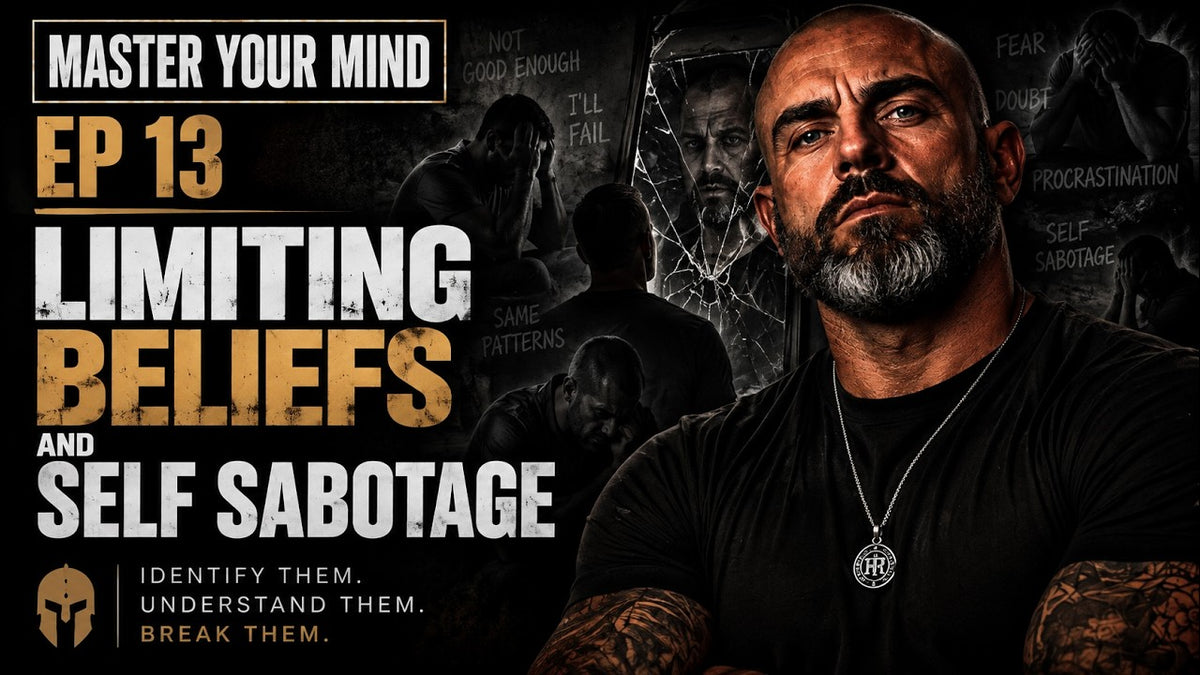
Why "Just Try Harder" Was Never the Problem: Limiting Beliefs and Self-Sabotage
Watch the full episode: Master Your Mind EP13 – Limiting Beliefs and Self-Sabotage
Nobody talks about the version of self-improvement that doesn't involve just trying harder. Online, discipline gets sold as a faultless, no-off-days performance — and when you inevitably fall off, the story you're handed is that you didn't want it enough. I don't think that's true for most people, and I definitely don't think it was true for me.
Where the pattern actually comes from
A lot of us grow up around people who don't put themselves first — who start something and stop, promise a thirty-day habit and quietly let it go. At a young age, that instills a behavior in you whether you're aware of it or not. So when you later "fail" to stick to something, you mistake it for a discipline problem or a willpower problem, when really it's an inherited pattern running quietly in the background. That mistake turns into a shame loop: you want to change, you fall short, you feel ashamed of falling short, and the shame makes the next attempt even harder. You end up feeling like you're always starting and never finishing.
I saw this pattern in my mum long before I recognized it in myself. Her mum wasn't a forgiving woman, and my mum copped a lot of flack for not very much at all. Growing up around that, her self-worth wasn't where it needed to be — she'd inherited a belief that she wasn't good enough. She'd start the gym, go well for a month, two months, three months, and then it would end. I used to just tell her to try harder. I didn't understand the mechanics back then. I've since watched this exact pattern repeat in people from every walk of life, everywhere — it isn't unique to one family or one country.
I did the same thing
I started training at fifteen. I'm forty-three now. That doesn't mean I never missed a day. For a long stretch, I expressed the exact same start-stop pattern my mum did, even with a genuinely supportive family behind me. I'd fall off, then tell myself I needed more discipline, more willpower — never questioning where the pattern actually came from, because I didn't know any different.
Here's the part that still surprises people when I explain it: I became most consistent, most disciplined, during the worst period of my life — after rock bottom, after leaving a life I'd built for nine years, through eighteen months of isolation. Not before it, when things looked technically fine. That's when I finally understood the pattern wasn't just about bad situations or bad people around me. It was about what I actually believed about myself.
Radical responsibility, not blame
Growing up, my family had accepted a shared story: we were the ones who got screwed over, second best, not quite good enough. No one had ever said those words to us directly — but the mindset we adopted in response to what happened did more damage than the events themselves. That's a hard thing to sit with, because it's so much easier to point at what happened to you than to turn the mirror around. But your perception of reality shapes the reality you end up creating. If you expect things to go wrong, more often than not, they will.
I didn't feel worthy of love. I didn't feel worthy of being in the best shape of my life, or having better people around me. That wasn't arrogance holding me back — it was the opposite. Ironically, when I saw people who actually believed they deserved good things, I used to read that as arrogance too, because I didn't have it myself.
The shame loop, honestly
When you're stuck in that loop, how is anyone supposed to get up and prioritize their own health, their training, their own life? You don't yet have the ability to say "I deserve more than this." These limiting beliefs are what actually block the clarity you need to be happy — not laziness, not lack of willpower.
It matters beyond just you, too. Kids absorb what you do, not what you say. Starting and stopping, believing you're not enough — that rubs off. If you've got a family, how you show up daily is teaching them how to believe in themselves, whether you mean it to or not.
What actually broke the pattern
Journaling. We're exceptional at lying to ourselves — it's part of the ego. Writing something down with a timestamp, when you broke a promise to yourself, makes it a lot harder to deny. It's not relying on memory, which is already stretched thin. Over time, journaling let me see my own patterns literally on paper.
Small wins. Once I could see the pattern, it got easier to interrupt it. Every time I broke the pattern instead of repeating it, that built motivation and confidence — because I was keeping my word to myself.
Honesty. It's easy to blame work, time, family. Sometimes those are real. But most of the time, the honest answer is you chose to concede to the old pattern. That's not meant to pile on shame — extenuating circumstances are real, and missing a day or two is recoverable. It's when the pattern quietly becomes weeks, months, years that you've actually broken your word to yourself.
About eighty percent of real confidence, in my experience, doesn't come from how you look. It comes from knowing what it took to get there — the choices you made when you didn't feel like it. That's also why people who've actually put the work in rarely put anyone else down for where they're at. The people who do that are usually further from where you are than you think.
The question worth sitting with
Why don't you deserve this? Whatever "this" is for you — a body, a relationship, a level of stability. Most people struggle to answer that honestly, because there usually isn't a real reason. We're all human. If someone else has what you want, there's no fundamental difference between you and them — just a belief that's standing in the way.
This one's a bit of an experiment for me — a shorter, more direct video than usual. If it's useful, I'd genuinely like to know, and I'm open to going deeper on any part of it.
Previous: The Ego Death (EP12) | Next: Isolation (EP14)